
Removed, Yet Not Rejected
Part 15 of 30 of Return to Eden: The Long Road Home, Reflection on Genesis 1-11

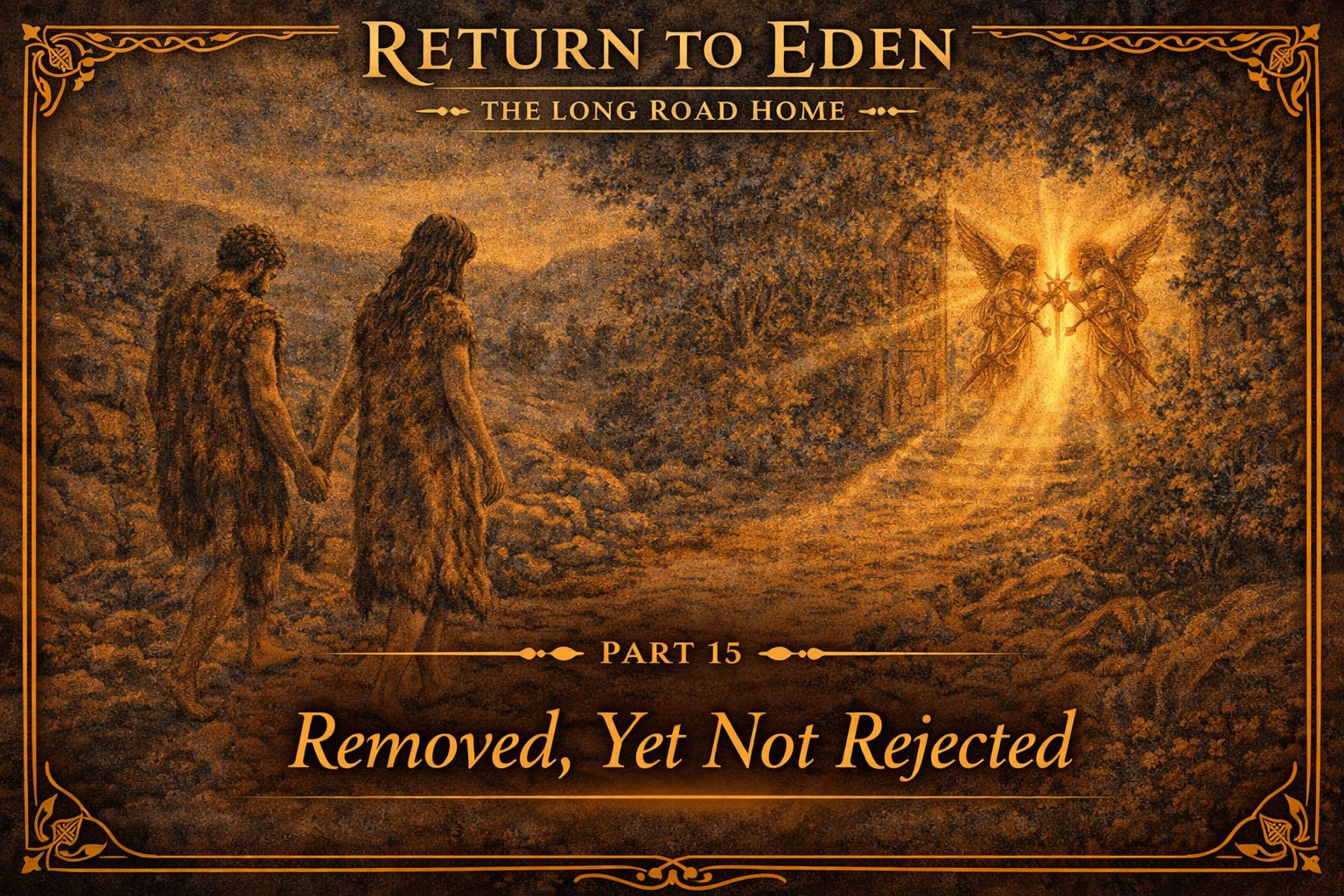
The garden did not end in chaos.
It ended with a sending.
“Therefore the Lord God sent him out of the garden of Eden to till the ground from which he was taken.”
— Genesis 3:23
Adam and Eve left the place they were made for, and there is profound tragedy in that fact.
The trees remained, the river still flowed, but they were no longer within its boundaries. The source of the Tigris, the Euphrates, the Pishon, and the Gihon still sent forth the waters, but its primary inhabitants were gone.
This was the moment we often think of as pure loss.
And it is loss.
Something real had been broken. The harmony of Eden was no longer their home. What was once natural now lay beyond reach. The closeness they once knew could not be returned to simply by turning around.
Make no mistake. This was an ending. But, as is always the case with the Ancient of Days, it was also a beginning.
And the earliest church fathers saw this.
They noticed what comes just after:
“He placed cherubim at the east of the garden… to guard the way to the tree of life.”
— Genesis 3:24
At first, it feels like a closing…A barrier…A final separation.
But St. Gregory the Theologian and others suggested something deeper: this guarding is not only about keeping humanity out—it is also about keeping humanity from something worse.
It is human tendency to return too soon. We want to reach for total restoration while we are still fractured. And in so doing we can live forever in a broken state.
So exile becomes a kind of mercy in this case. And in ours.
God does not abandon humanity to endless corruption. He prevents them from sealing their condition permanently. The way back is not erased—but it is delayed, protected, and transformed into a journey.
They are sent out…
so that one day, they may truly return.
We were off roading in Tennessee, enjoying a really adventurous trail when, out of nowhere, we came upon a trail that was blocked. And we were disappointed to think of what that blockage was keeping us away from. By the end of our journey, however, we learned that it wasn’t there to keep us from reaching our destination, but to keep us from riding into danger we could not yet see.
We were redirected.
The way becomes longer, less direct, and more demanding.
But also… safer.
Genesis tells us that humanity begins its life east of Eden.
And that is where we still live.
Outside the garden.
Working the ground.
Remembering, even if faintly, that we were made for something more.
Yet even here, the story is not finished.
Because the One who sent humanity out has not withdrawn His presence. The road away from Eden is also the road on which God continues to walk with His people.
The long road home begins here—not with an immediate return, but with a journey shaped by mercy.
We are sent out, but not abandoned. We are removed, yet not rejected.
And the way back, though guarded, is not gone.
Hopelessness is the belief that the way home does not exist, but it does. It does exist. And on its gate a new name is written…
New Jerusalem.
Good thoughts!